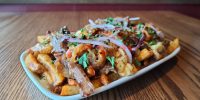
| “Co-branding” (e.g. Certified Angus burgers.) is another form of descriptive text that uses values constructed by other successful brands to add value to menu items. The same psychology that empowers descriptive text, demands descriptions be truthful and accurate. If a product’s region is specified, the product must be from that region. Co-branded items cannot substitute other brands. Items described as “crispy” impose customer expectations that must be met. Beyond ethical and legal implications, failure to deliver on customer expectations can do more harm than if the description was not used in the first place. Visibility Another study found customers read menus for only 109 seconds on average. Having less than two minutes to promote offerings, has menu design implications. First, regardless of the type or style of menu being designed, it should be uncluttered, easy to read and as concise as possible. This will reduce the time required to scan each item on the menu and increase the likelihood that customers see every item. Second, you will need to help the customer find the items you want to sell (profitable) and that you think they want to buy (popular). Never assume the customer will find these on her own. The following tactics can increase item visibility: Item order: Studies have shown that items at the top and bottom of lists with six or more items will typically outsell items “buried” in the middle of the list. Position: For decades, menu designers have included relative positioning of menu items in a suite of tactics to increase menu performance. The theory is based on gaze motion studies that predict the path customers’ eyes follow on a menu and identify “sweet spots” where items are more prominent. Recent scientific studies have tested the eye movement theories and their effect on sales with varying results. Nevertheless, industry convention suggests that there is truth to the theory, even if results vary due to the other factors identified in this article. Pictures: Pictures can effectively increase menu item sales because they help customers envision what they are ordering – lowering the purchase risk. Before using pictures on your menu, consider the following: - Accuracy: Like descriptive text, pictures must accurately represent the components, garnish and presentation of the dish or customers’ expectations will not be met.
- Formatting: Formatting such as font type, size, style and colour, placing a box around select items, and background colour can draw attention to menu items you want to sell.
Economics Price can influence both item profitability and popularity. In fact, experience suggests that changes in price have a somewhat greater effect on menu profitability than other design variables, making price a critical component of menu design. Before setting prices, you need an accurate idea of items’ cost. Remember to include less obvious costs like product yield loss (e.g. vegetable peels, cooking shrinkage) and remainder-of-meal costs like bread, packaging and condiments. These items can have significant impact on profitability. Finding optimal prices is not always easy. Too high and you risk losing business. Too low and you risk leaving money on the table, or worse, lowering the perceived value of your brand. Several market research and analysis methods exist for pricing. However, smaller operators may not have the necessary resources for some. A simple approach for setting initial prices is to divide menu item cost by the desired food cost ratio, then testing that price against the prices of key competitors and adjusting accordingly. Unfortunately, this approach misses opportunities based on customer preference and perceived value. Once you have some sales data, however, use of menu analysis tools like menu engineering or cost margin analysis can be used to understand customers’ price-sensitivity and identify opportunities to increase or lower prices to maximize total margin. Menu design is both a science and an art. Designers should apply scientific methods to maximize a menu’s performance, but recognize that every operation is different. Some tactics and approaches may have significant impact on one menu but less for another. For this reason, menu design should be considered an ongoing exercise of monitoring, analysing and adjusting to find what works best for the operation. Finally, keeping in touch with evolving research and menu design theory will help operators offer menus that they can R.A.V.E. about. See also:
About the author Andrew Waddington is a Vice President of fsSTRATEGY Inc. business strategy consultants to the foodservice industry. Visit them at www.fsSTRATEGY.com. |