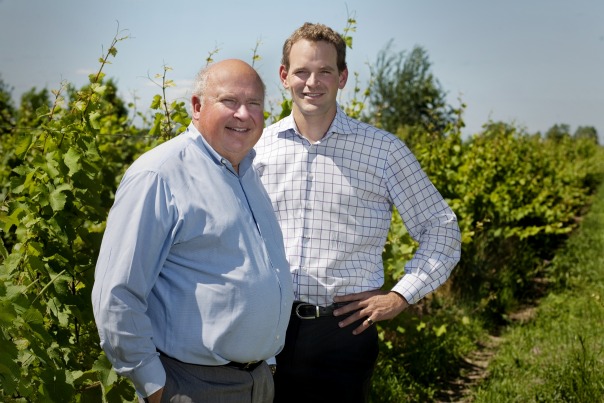
One of Canada’s better known and more successful virtual wineries is Sandhill. Made under the umbrella of Peller Estates, Sandhill wines are small production, single vineyard, high quality VQA wines made by veteran BC winemaker Howard Soon. Despite the lack of its own winery, Sandhill is committed to quality and has the accolades to prove it. In Ontario, virtual labels created with the same passion as Sandhill include Featherstone, Charles Baker and Union. Union, made by Canadian wine industry pioneer Allan Jackson (the ‘Jackson’ in Jackson-Triggs, in his second career) is unique as far as Ontario’s virtual wineries go, as it has its own manufacturing license. So while Union uses another winery’s crush facilities, it does not need to create its wines under another winery’s umbrella. Allan Jackson (left) and Andrew von Teichman make wines from various Niagara vineyards for their Union virtual winery. Photography by Adam Belnap. Back in British Columbia, those in the know have their eyes on Haywire, a virtual winery opened in 2010 by wine industry marketing veteran Christine Coletta, and her husband Steve Lornie. Haywire is the first offering from a larger plan the couple has – operating a custom crush facility. Haywire was made offsite at other wineries in its first two vintages, and now plans are underway to break ground in spring 2011 on Okanagan Crush Pad. Okanagan Crush Pad will be the Okanagan’s home for other virtual wineries, offering a custom crush facility for small wineries that can benefit from shared resources. Two of Okanagan Crush Pad’s first customers will be David Scholefield and Michael Bartier who are collaborating with consulting winemaker Alberto Antonini and Master of Wine Rhys Pender who has vineyards in the Similkameen Valley. From crush and winemaking, to tank and barrel storage, lab work, packaging and marketing, a virtual winery collective offers advantages to winemakers that want to make small lot wines but do not yet have the capital or even the desire to open a winery. They can avoid wrangling with financial institutions for funding, huge capital start-up costs, and operating expenses. Additionally, virtual wineries have an ecological advantage. There are less buildings to leave footprints in agricultural areas, and shared equipment means less equipment is needed to be constructed and shipped. The best thing about Canada’s virtual wineries is the wines they produce. The growing emergence of virtual wineries across the country is resulting in smaller batch, interesting wines that express what Canada’s unique terroir can offer. | |