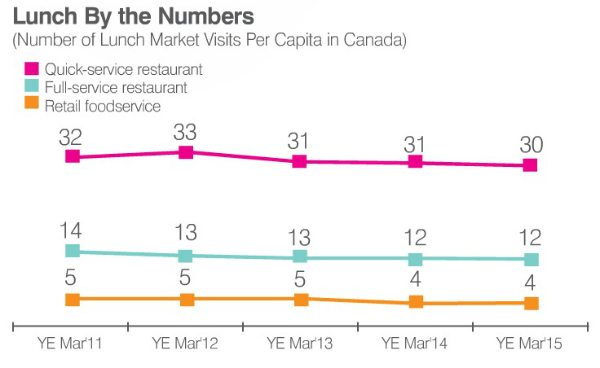
| While external pressures, both social and economic, are likely having an impact on consumers’ lunch restaurant visit patterns, not all restaurants have seen a fall-off in lunch business. This is certainly the case for the “new kid on the block” in Canada – “fast casual” restaurants. Fast casuals are the fastest growing lunch destinations for Canadians. Because the overall lunch market is not growing, the success of fast casuals has been the result of “stealing” visits from other concepts. In the last year alone, fast casuals have earned $27 million at lunch. A good portion of that growth has come from an ability to garner a higher average check than traditional quick-service restaurants — $2.33 higher! As if that isn’t enough, they are also attracting visits from that all-important millennial generation. While Millennials in general have cut back on their use of restaurants, they have increased their visits to fast casual restaurants – six out of 10 visits to fast casual restaurants in Canada are by Millennials. Understanding what is behind the success of Fast Casuals can help operators and manufacturers identify market opportunities. Additionally, knowing why consumers are ordering fewer lunch meals will be an important part of developing products and promotions to drive lunch traffic. More people are eating lunch at homeAs mentioned earlier, changing lifestyles and time pressures are often given as reasons for many of the shifts in consumer behaviour that have occurred in the restaurant industry over the last few years. Another variable is that more people work at home. As communication and information technologies advance, workers are increasingly able to work from home, and many do. Since work often dictates how people organize their lives, changes in work patterns have both economic and social implications. According to the U.S. Census Bureau, in 2010, 13.4 million Americans worked from home, with about 1.8 million here in Canada in 2008 (the most recent year for available statistics). That number is likely much higher today due to continued advances in technology, and the rise in professionals creating second careers after losing their jobs during the recession. It is very likely that the vast majority of these consumers do not go out to restaurants for lunch. The keys to building lunch trafficTaken together, these trends leave us with many questions. Have Canadians become too busy for lunch? Are they skipping lunch to save some money? Are there any changes operators can make in order to entice more lunch visits? While these questions are bigger than any one survey, a review of NPD’s CREST® Voice of the Consumer data yields numerous suggestions on how to enhance the lunch experience for customers. Here’s a look at what consumers told us: “What, if any, suggestions do you have for this restaurant or eating place that would have improved your experience from yesterday?” - Building loyalty / value – Loyalty card; promotions/coupon; lower prices
- Upping the ante on customer service – Knowledgeable, attentive staff; faster service; accuracy of order
- Focus on food variety/quality – Keep it fresh; keep it healthy; variety; portion size
- Getting back to basics – Cleanliness; temperature; drive-through; parking; temperature of food
Even though Canadians are visiting restaurants less frequently for lunch, growth opportunities still exist. Not all concepts have experienced traffic losses at lunch. Those that have been able to meet consumers’ needs have experienced lunch growth despite this daypart’s overall weakness. Understanding shifts in consumer usage and attitudes will help restaurant operators and their supplier partners redefine what consumers want from their restaurant lunch meal experience. See also:
About the author: Mark Dempsey is Director, Foodservice Canada for The NPD Group. The NPD Group has more than 25 years of experience providing reliable and comprehensive consumer-based market information and insights to leaders in the foodservice industry. For more information, visit www.npd.com or contact Mark at [email protected]. | |